
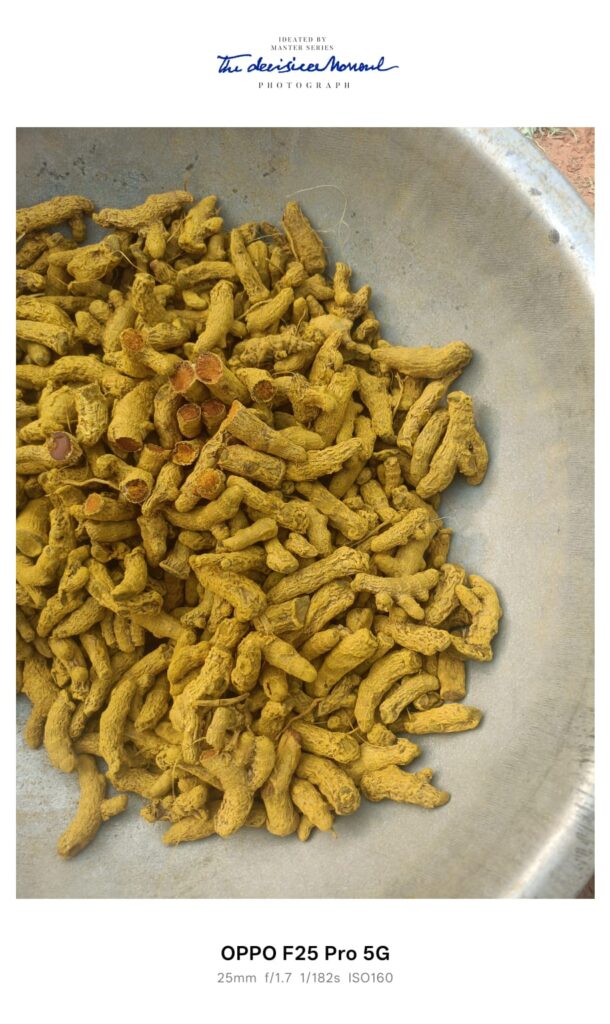
When people talk about turmeric, the conversation often revolves around curcumin—the active compound responsible for turmeric’s bright yellow color and many of its health benefits. High-curcumin turmeric varieties often receive the spotlight, but there is another important variety that plays a significant role in the turmeric industry: the Hybrid Variety Turmeric found in Assam’s Hojai district.
A Unique Turmeric from Hojai
Hojai district, located in the heart of Assam, is known for its fertile soil and favorable climatic conditions for agriculture. Among its many agricultural products, Hybrid Variety Turmeric has emerged as an important crop for local farmers and traders.
Unlike premium turmeric varieties that contain high levels of curcumin, Hojai’s hybrid turmeric generally contains curcumin levels ranging from 0.5% to 1.5%. While this percentage is comparatively lower, it does not diminish the commercial value of this variety.
Why is Hybrid Turmeric Important?
The turmeric processing and spice industries require different grades of turmeric for various applications. High-curcumin turmeric is often expensive and may not always be available in sufficient quantities. This is where Hojai’s hybrid turmeric becomes valuable.
The hybrid variety is widely used for blending with high-curcumin turmeric. By mixing different grades, manufacturers can achieve specific curcumin concentrations required for various products, including:
Turmeric powder
Spice blends
Food processing products
Herbal formulations
Industrial turmeric extracts
This blending process helps maintain product consistency while optimizing production costs.
Benefits for Farmers
The cultivation of hybrid turmeric provides several advantages to farmers in Hojai district:
Good Adaptability
The variety performs well under local agro-climatic conditions, making it a reliable crop for many farmers.
Stable Market Demand
Since turmeric processors and traders require blending material, there is consistent demand for this variety throughout the year.
Income Generation
Turmeric cultivation serves as an important source of livelihood for numerous farming families in the region, contributing to the local rural economy.
The Role of Hojai in the Turmeric Supply Chain
Although Hojai’s hybrid turmeric may not compete directly with premium high-curcumin varieties, it occupies a strategic position in the turmeric value chain. Its role as a blending component makes it an essential raw material for spice manufacturers and traders across India.
The district’s farmers have developed significant expertise in turmeric cultivation over the years, helping establish Hojai as a recognized turmeric-producing region in Assam.
Future Opportunities
With growing awareness of turmeric and its applications in food, cosmetics, and wellness products, there is potential for further development of turmeric cultivation in Hojai. Better post-harvest practices, improved processing facilities, and stronger market linkages can help farmers achieve greater value from their produce.
Research into improved hybrid varieties and cultivation techniques may also help increase yield and quality while maintaining the characteristics that make this turmeric suitable for blending purposes.
Conclusion
The Hybrid Variety Turmeric of Hojai district may not boast the highest curcumin content, but it serves an important function in the turmeric industry. With curcumin levels ranging from 0.5% to 1.5%, it provides a practical and commercially valuable blending material that supports manufacturers and processors across the market.
Behind every premium turmeric product lies a supply chain that depends on different varieties working together. Hojai’s hybrid turmeric is a perfect example of how a seemingly ordinary crop can play an extraordinary role in the agricultural economy of Assam and beyond.